Royal Marsden and Johann de Bono
Studies AR-NTD disease biology in prostate cancer at The Royal Marsden and ICR.

- Institution
- The Royal Marsden and The Institute of Cancer Research ↗London, United Kingdom
- Partner lead
- Prof. Johann de Bono →Regius Professor of Cancer Research
- Program
- AR-NTD antagonist →IND enabling
- Focus
- Castration-resistant prostate cancerAR splice variantsBiomarker-driven translation
Why we partner
AR-NTD binders have to be understood in the same resistance landscape that defines prostate cancer care today.
Peptone works with Prof. Johann de Bono at The Royal Marsden and The Institute of Cancer Research to connect its disordered-domain chemistry to clinical disease biology.
That includes the splice-variant and biomarker contexts that decide whether a therapy directed at AR-NTD can matter for patients.
Scientific focus
Prof. de Bono leads prostate cancer targeted therapy and drug development programs that have shaped the treatment of advanced disease.
His group's work on androgen receptor aberrations, including constitutively active splice variants such as AR-V7, showed why therapies that only occupy the ligand-binding domain leave an escape route open.
That clinical and molecular framing is essential for AR-NTD mechanism-of-action studies.
Published evidence
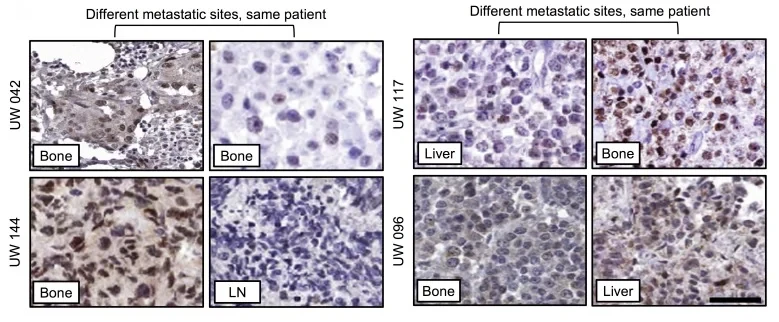
Metastatic castration-resistant prostate cancer biopsies stained for the androgen receptor splice variant AR-V7. Brown marks nuclear AR-V7; paired panels are separate metastases from the same patient. AR-V7 lacks the ligand-binding domain and keeps androgen receptor signaling active through the N-terminal domain after standard antiandrogens fail.Sharp et al., Journal of Clinical Investigation, 2019 (Fig. 6A, cropped)CC BY 4.0 What Peptone brings
Peptone brings small molecules designed against the disordered N-terminal domain, characterized by ensemble measurement rather than an assumed static pocket.
The Product Engine supplies compounds, biophysical engagement data, and a clear hypothesis.
That hypothesis is to shut down the transcriptional activation function that resistance mechanisms continue to exploit.
What we do together
The collaboration studies how Peptone AR-NTD compounds behave in models and experimental systems informed by clinical resistance.
Those systems draw on circulating biomarkers and the genomic landscape of lethal prostate cancer.
The aim is to test mechanism of action early, with translational insight that is difficult to recreate in isolation.
Therapeutic aim
The aim is a first-in-class AR-NTD drug candidate with a clearer path from measured binding to patient-relevant biology.
Clinical prostate cancer models and biomarker work deepen the understanding of the disease.
That understanding decides which molecules advance and which do not.